

Performance Indicators: Learn how to evaluate the success of your e-commerce
Performance indicators serve to evaluate and measure the success level of key processes for a company.
By determining a set of indicators, the manager can evaluate the performance of the e-commerce business and the effectiveness of its strategies.

Performance Indicator Models for E-commerce
Performance indicators, also called KPI (Key Performance Indicator) are metrics that quantify a business’s performance against organizational goals.
As the name itself suggests, an indicator is a metric that indicates something useful, relevant, and helpful in decision-making.
Although several performance indicator models exist, each company selects the ones it will use in a unique way, as they must reflect its strategy.
Thus, in the area of logistics, for some companies an important indicator will be related to time, while for others it will be cost or quality.
For these performance indicators to fulfill their role correctly, it is first necessary to carry out strategic planning and have clarity regarding the goals that must be achieved.
From there, defining and managing these indicators helps monitor the evolution of your e-commerce business through the results obtained.
To help you define which performance indicators to use in your online store, we have compiled several models that provide highly relevant data for e-commerce.
Conversion Rate
An important metric for any e-commerce business, the conversion rate shows how many people visited your website and took some action, such as filling out a contact form or completing a purchase.
This is a very important metric for evaluating the effectiveness of marketing campaigns and strategies.
The higher the conversion rate, the greater the chances that your strategies are actually attracting customers.
To calculate this rate, simply use the following formula:
(Number of visitors who performed some action / Number of visitors) x 100
The ideal conversion rate varies depending on the company’s goal, linked to the value of the products and services that it offers.
See, for example, the following estimate:
- Stores with high-value products: ideal rate between 1% and 2%;
- Stores with more affordable items: the fee usually ranges between 2 and 3%;
- When actions target other actions (clicks, registrations, etc.) instead of purchases: conversion rate between 5% and 20%.
If the percentage value is too low, you need to review your strategies and find out what is not working and what needs to be improved.
– How to use email marketing to sell more
Average ticket value
This performance indicator aims to determine the average amount a customer spends on your e-commerce website.
Knowing this number allows you to understand how many customers your online store needs per month to reach its sales target.
This result also makes it possible to know if the average value is greater than the amount invested to attract customers, signifying profit or loss.
The standard calculation of average monthly ticket size is as follows:
Total sales revenue ($) / Number of completed sales
If the result isn’t good, don’t worry, there are several ways to increase the average ticket value, such as:
- discounts starting from a certain amount;
- loyalty programs;
- customer-friendly shipping policy;
- varied delivery options;
- promotions, among other things.
Remember that it’s necessary to set objective goals that are consistent with the company’s business model.
– How to offer a customer loyalty program in e-commerce
Bounce rate
Also known as rejection rate, the rejection rate, according to Google Analytics definition, signals “the percentage of single-page sessions” (that is, sessions in which the person left your site on the landing page without taking any action).
Unlike the Exit Rate, which shows how many people left your website regardless of whether it was the first page visited or not, the Bounce Rate can occur in several ways, such as:
- The user closed the page/tab;
- The visitor typed a new address into the browser;
- The visitor clicked on a link that took them to another website;
- The user was inactive for more than 30 minutes (Google Analytics default).
The value of a bounce rate depends on several factors, such as the market and the website’s objective.
See a table with the Average Rejection Rate, divided by different types of sites:
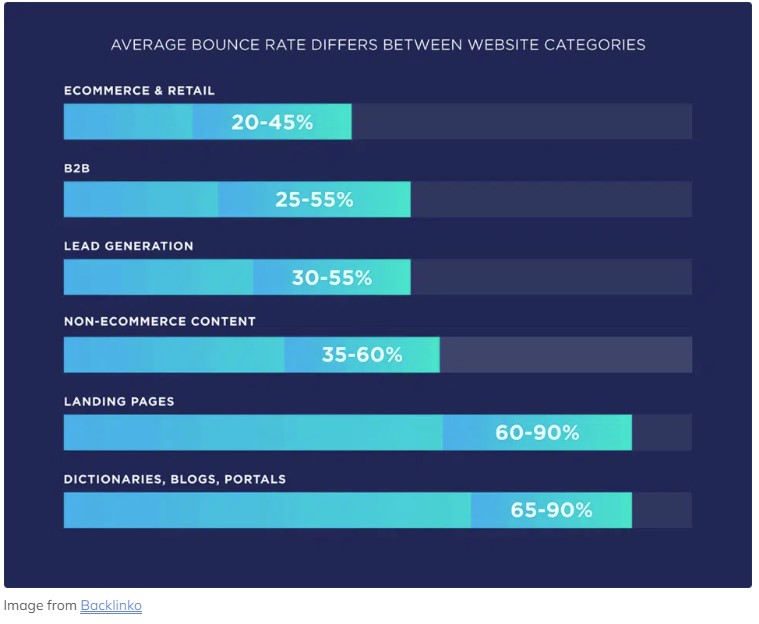 To calculate the rejection rate, use the formula below:
(Number of visitors who leave without interacting with the page / Total number of visitors) x 100
According to the data, if your e-commerce bounce rate is below 20%, perfect, celebrate!
In the American market, for example, the average rejection rate is approximately 34%, with large stores having rates as low as 10%.
Abandoned shopping cart
Among the performance indicators, this one is very important because it applies directly to online stores.
The infamous abandoned cart occurs when a consumer browses the website, selects items to buy, and then abandons the purchase.
According to research conducted by E-commerce Radar, the average shopping cart abandonment rate in e-commerce is around 70%.
Several factors can contribute to an increase in this rate, such as:
- Shipping cost higher than expected;
- Technical problems on the page;
- Lack of payment options;
- Long delivery time;
- Excessive processes that make it difficult to complete the purchase.
To find out if your e-commerce shopping cart abandonment rate is high or not, use the following formula:
(Number of users who add a product to their cart / Number of customers who complete the purchase) x 100
One of the biggest challenges for e-commerce managers nowadays, shopping cart abandonment rates can directly influence conversion rates, and it’s necessary to analyze, discover, and fix what might be causing this problem to recur.
– How to prevent shopping cart abandonment in e-commerce
Key Performance Indicators and Successful E-commerce

All performance indicators are equally important, as they provide insight into what the company needs to improve in its processes.
Through regular measurement of results, the e-commerce manager can perform the necessary interventions based on relevant and reliable information.
This is fundamental in the task of leading the store to achieve consistent results, ensuring its sustainability.
Pay attention to the factors that most frequently arise as reasons for customer dissatisfaction, such as shipping costs and delays in product delivery.
Focused on ecommerce and express delivery, the app Delivery365 is a complete solution for your business.
Among the advantages that the app offers are:
- Own online freight quotation system;
- Tracking code;
- Ways to receive payment online;
- Base of hundreds of registered delivery people.
– How to calculate shipping for e-commerce
All this to ensure the viability and perfect functioning of your e-commerce and online sales.
Visit our website, get to know our services, and offer the best delivery solution for your customer.