

SKU in E-Commerce: What It Is and Why Your Store Needs It
Stock Keeping Unit – SKU, It’s a code that allows merchants to automatically track inventory in their stores.
The characters that make up the code are intended to provide product details, such as color, size, manufacturer, etc.
Essential for effective inventory management in e-commerce, here’s everything you need to know about it.

Why is SKU important?
SKUs are used by stores, e-commerce providers, service providers, warehouses, and product fulfillment centers to track inventory items.
Each company creates unique SKUs for its products and services that display details such as:
- collor
- size
- style
- price
- manufacturer
- brand
- material
Although these are the most common, not all of them need to be used, as we said, each store creates its own as it sees fit to inventory control.
See an example below:
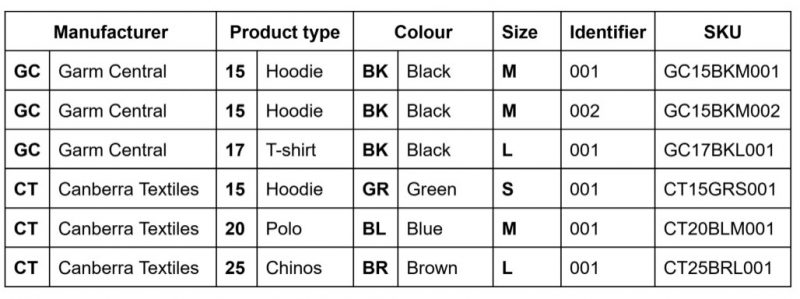
In general terms, an SKU is an item identity and the same can only be used for products that are exactly the same.
Therefore, if a company has 200 SKUs in its portfolio, this means that it has 200 different items available.
By adding this type of code to each product, retailers can easily track its location in the warehouse and the quantity of products available, making it easy to know when new purchase orders should be placed.
It is also possible to know if a product has been sold, delivered, returned, or exchanged, making inventory management easier.
– Inventory management: 6 effective methods to use in your e-commerce business
How do I determine an SKU for my products?
A SKU will typically appear on a product along with its barcode.
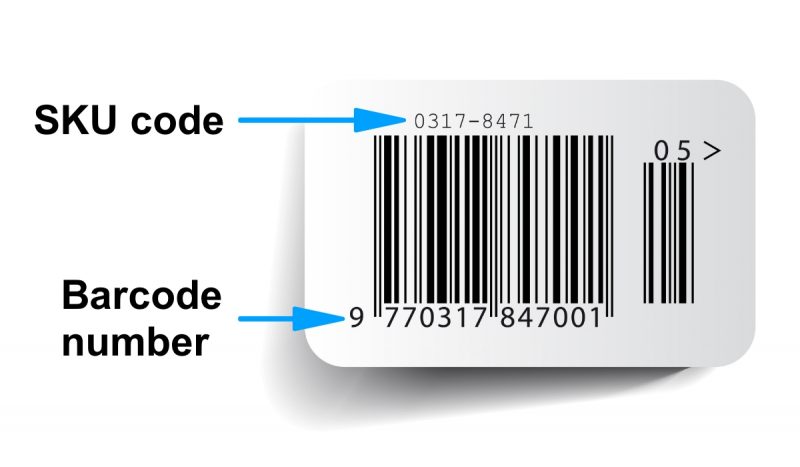
Since these numbers are intended for the producer/seller to control the items, they are company specifics.
This means you can create any SKU system that meets your needs for your products.
The recommendation is that you create a system that maintains consistent logic, starting with top-level identifiers followed by more unique and specific codes, like the example below.
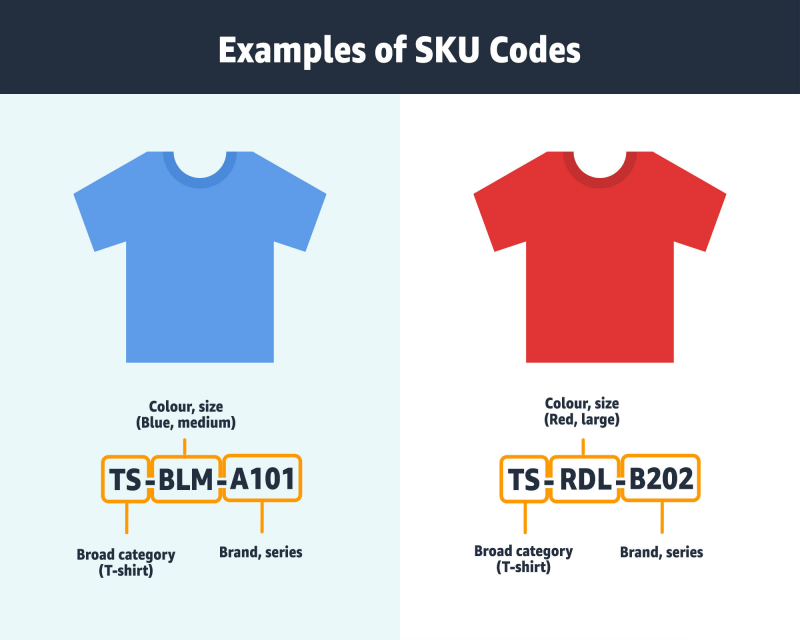
This code facilitates communication between the team, especially in larger companies that work with hundreds of items and handle a huge data volume.
Having an SKU code streamlines processes and allows tracking products and sales more easily. In addition, it makes it less likely that the wrong item will be sent to customers.
– 7 Advantages of Order Tracking in E-commerce
3 ways to use SKUs in your e-commerce business
The main retail functions of a stock keeping unit include:
- Refueling calculation
- Sales forecast
- Upselling and cross-selling
1. Refueling calculation
Using SKU data, you can monitor product status and calculate when you will need to buy more to replenish your stock.
By tracking how quickly each SKU sells over a given period, you can predict when you should place another order with your supplier.
2. Demand and sales forecasting
Using an SKU system also means more accurate sales and demand forecasting.
By analyzing these inventory data you can find out which are the peak sales periods, which items sell the most, and how much more you should keep in stock.
Similarly, it’s possible to identify products with low sales in order to reduce inventory accordingly.
– How to forecast demand in e-commerce
- Upselling and cross-selling
Product codes can also be applied in the sales area or within an e-commerce checkout.
SKUs enable cross-selling and upselling recommendations for similar products.
For example, if a customer is buying a laptop, the SKU data might suggest compatible items, such as a laptop bag or wireless mouse, improving the shopping experience and increasing sales.
– E-commerce checkout: how to improve the customer experience
How using a SKU helps with logistics in e-commerce

Companies need to monitor their inventory to know how much they are selling, how often to restock, and how quickly items sell, among many other reasons.
The use of SKU simplifies the inventory process allowing for a significant amount of automation.
– Process automation and its benefits for your e-commerce
As we mentioned, this is particularly useful for large retailers that sell thousands of products.
In e-commerce, the use of SKU improves the inventory integration with the online store.
The categorization of available items helps prevent errors, such as sending the wrong order to a customer.
Assigning SKUs to each product also makes it easier to track shipments throughout the logistics process, from order receipt to delivery to the customer.
This is especially useful for quickly identifying the location of a product in transit.
In summary, the use of SKUs in e-commerce helps with logistics by providing better identification, control and tracking of products, which results in more efficient and accurate processes at all stages of the supply chain.
A platform ready for you to create your online store, the Delivery365 app offers advanced order tracking technology, its own freight quoting system, and secure online payment methods.
When registering your company on app Delivery365, you have access to a database of hundreds of delivery drivers, ensuring fast and specialized shipping.
To know more, visit our website, learn about our services and secure the best logistics service for your e-commerce business.